Stations
Process stations
A process station collects measuring data from different sensors and switches, it can be
analog measuring data as temperatures, flows, levels, or digital measuring data from
for example photocells or pressure switches. A control program is executed in the process
station, that from the measuring data calculates control data for the process that is sent
out to motors and actuators affecting the process.
Process stations often contains special hardware to read input data and write output data,
but this can also be performed over the network with protocols as Modbus/TCP and Profinet.
Operator station
The operator station is the interface between the operator and the process. The operator
supervises the process with the help of process graphs, displaying the state of the process
by presenting data in the shape of bars, curves, indicators etc. The operator can influence
the process, for example by entering data into input fields or pushing buttons in the process
graph.
Storage station
Some measuring data has to be stored, in order to view trends and changes, or to be able
to get back and analyze the state of the process at a certain point of time. The storage
time can vary from hours to several years. The storage is done on storage stations, that
have sufficient disk space to be able to store data for long periods, and also have backup
functions.
Development station
There can also be development stations on the network, where process, operator and storage
stations are configured and programmed. On the development stations there are tools to draw
process graphs, program sequences, logical schemas, control loops etc. When the
configuration is modified for a station, the new configuration is distributed to the station
via the network.
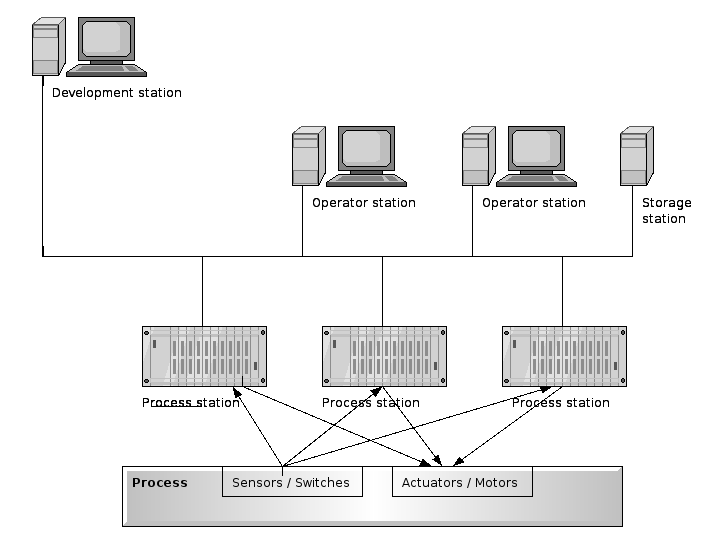
Fig Components in a ProviewR system