Class ApDistribute
|
| Version |
1.0 |
|
| Modified |
08-MAR-2026 11:05:32.00 |
|
| Code |
rt_plc_data.c |
|
 The ApDistribute expands the number of analog outputs that can be
 handled in a DataArithm object.
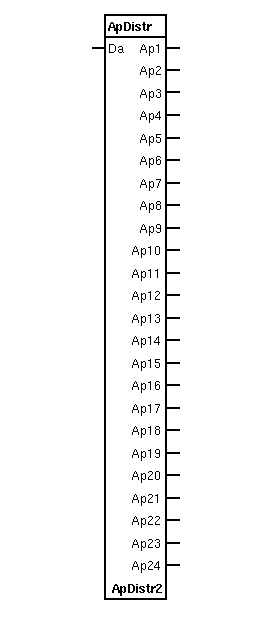
 The ApDistribute has 24 analog outputs, which values can be set from
 an array of Float32 declared in the code of a DataArithm. By connecting
 the data input of the ApDistribute to an data output of a DataArithm,
 and placing the address of the float array in the data output, the
 values of the array will be copied to the Ap output of the ApDistribute
 object. This expands the number of analog outputs from the DataArithm
 from ordinary 9 to 96, if all four data outputs are connected to ApDistribute
 objects.

 Another advantage of ApDistribute is that its sometimes convenient to have
 the values arranged in an array, for example to handle in an for or
 while loop.

 MaxIndex should be assigned the number of used outputs in the ApDistribute
 object. The value can be set at runtime or in the configurator.

 The array should be a static declared array of pwr_tFloat32, with size
 greater or equal to the value in MaxIndex. Use the type pwr_sApDistribute
 defined in $pwr_inc/rt_plc_data.h.
Example
 This is the code in a DataArithm witch has a ApDistribute object connected
 to the ODa1 output.

       static pwr_sApDistribute vect;
       int i;

       ODa1 = vect;
       for ( i = 0; i < 24; i++)
         vect[i] = 0.1 * i;
See also
|
RtBody attributes pwr_sClass_ApDistribute |
| Pointer to Void |
DataIn |
Da |
Data input connected to a data output of a DataArithm object.
|
| Float32 |
ApOut1 |
Ap1 |
The value of the first element in the array. |
| Float32 |
ApOut2 |
Ap2 |
The value of the second element in the array. |
| Float32 |
ApOut3 |
Ap3 |
The value of the third element in the array. |
| Float32 |
ApOut4 |
Ap4 |
The value of the corresponding element in the array. |
| Float32 |
ApOut5 |
Ap5 |
The value of the corresponding element in the array. |
| Float32 |
ApOut6 |
Ap6 |
The value of the corresponding element in the array. |
| Float32 |
ApOut7 |
Ap7 |
The value of the corresponding element in the array. |
| Float32 |
ApOut8 |
Ap8 |
The value of the corresponding element in the array. |
| Float32 |
ApOut9 |
Ap9 |
The value of the corresponding element in the array. |
| Float32 |
ApOut10 |
Ap10 |
The value of the corresponding element in the array. |
| Float32 |
ApOut11 |
Ap11 |
The value of the corresponding element in the array. |
| Float32 |
ApOut12 |
Ap12 |
The value of the corresponding element in the array. |
| Float32 |
ApOut13 |
Ap13 |
The value of the corresponding element in the array. |
| Float32 |
ApOut14 |
Ap14 |
The value of the corresponding element in the array. |
| Float32 |
ApOut15 |
Ap15 |
The value of the corresponding element in the array. |
| Float32 |
ApOut16 |
Ap16 |
The value of the corresponding element in the array. |
| Float32 |
ApOut17 |
Ap17 |
The value of the corresponding element in the array. |
| Float32 |
ApOut18 |
Ap18 |
The value of the corresponding element in the array. |
| Float32 |
ApOut19 |
Ap19 |
The value of the corresponding element in the array. |
| Float32 |
ApOut20 |
Ap20 |
The value of the corresponding element in the array. |
| Float32 |
ApOut21 |
Ap21 |
The value of the corresponding element in the array. |
| Float32 |
ApOut22 |
Ap22 |
The value of the corresponding element in the array. |
| Float32 |
ApOut23 |
Ap23 |
The value of the corresponding element in the array. |
| Float32 |
ApOut24 |
Ap24 |
The value of the corresponding element in the array. |
| Int32 |
MaxIndex |
|
Number of used outputs. This value has to be supplied by the user. |
| GraphPlcNode |
| object_type |
11 |
| parameters[0] |
1 |
| parameters[1] |
2 |
| parameters[2] |
24 |
| parameters[3] |
0 |
| subwindows |
0 |
| graphmethod |
16 |
| graphindex |
0 |
| default_mask[0] |
1 |
| default_mask[1] |
3 |
| segname_annotation |
1 |
| compmethod |
4 |
| compindex |
0 |
| tracemethod |
0 |
| traceindex |
0 |
| executeordermethod |
2 |
| objname |
ApDistr |
| graphname |
ApDistr |
| debugpar |
|
| Template Object |
| MaxIndex |
2 |
Attributes detail
 Data input connected to a data output of a DataArithm object.
 In the DataAritm code, the address of en array should be placed in
 the connected data output.
The value of the first element in the array.
The value of the second element in the array.
The value of the third element in the array.
The value of the corresponding element in the array.
The value of the corresponding element in the array.
The value of the corresponding element in the array.
The value of the corresponding element in the array.
The value of the corresponding element in the array.
The value of the corresponding element in the array.
The value of the corresponding element in the array.
The value of the corresponding element in the array.
The value of the corresponding element in the array.
The value of the corresponding element in the array.
The value of the corresponding element in the array.
The value of the corresponding element in the array.
The value of the corresponding element in the array.
The value of the corresponding element in the array.
The value of the corresponding element in the array.
The value of the corresponding element in the array.
The value of the corresponding element in the array.
The value of the corresponding element in the array.
The value of the corresponding element in the array.
The value of the corresponding element in the array.
The value of the corresponding element in the array.
Number of used outputs. This value has to be supplied by the user.