
| Volume pwrb | |
| Attributes: Runtime | Development | System | Template | Detail C Binding: Struct | Class ClassTree | INDEX NO INDEX |
|
Class ChanDo
|
||
|---|---|---|
| Version | 1.0 | |
| Modified | 08-MAR-2026 11:05:32.00 | |
 Configures a digital output channel independent of the
 type of physical Do-card.

 Figure below shows the steps in Do-signal conversion.
 ActualValue belongs to the Do object. The shadowed
 attributes are defined in a card object, the Emerg-attribut
 in a $Node object, and the rest in the ChanDo object.
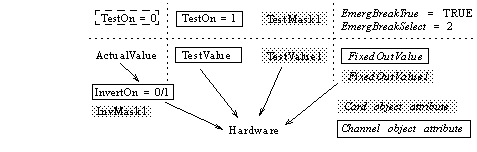
 Attributes Used in Do-signal Conversion

 If EmergBreakTrue = TRUE and EmergBreakSelect = 2 then
 the output is based on FixedOutValue. Otherwise TestOn
 will settles which attribute the output is based on.
Hints
 ChanDo objects are configured below a suitable Do-card
 object.
 Rack and card objects to different I/O systems are
 documented separately.

 To create card object with channel objects belonging to
 it the function 'Configure Card' in "Utility Window" is
 recommended.
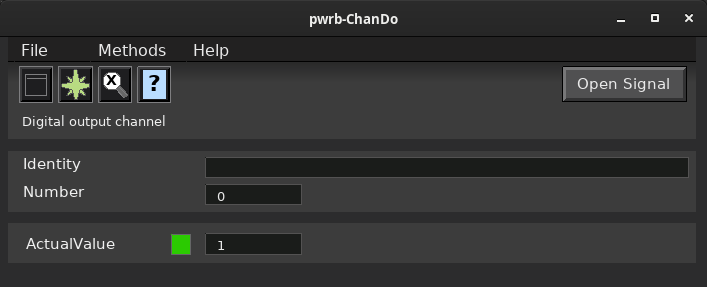
Object graph
| RtBody attributes pwr_sClass_ChanDo | |||
|---|---|---|---|
| String104 | Description | Optional text, for example to describe the channel or its employment. |
|
| AttrRef | SigChanCon | Name of a signal object, i.e. Do object, connected with the channel object. |
|
| String80 | Identity | The identity of the channel. Optional, for example Do0 to denote the first channel, physical cable marking, |
|
| UInt16 | Number | The Number attribute is used to associate the ChanDo object to a fixed channel on the card named by SigChanCon. The physical channels of the card are numbered in the interval {0,1, ... , (MaxNoOfChannels-1)}, where MaxNoOfChannels is an attribute in the card object. The channels of the card are numbered according to the instructions of the card manufacturer. |
|
| Boolean | InvertOn | Specifies if the ActualValue should be inverted or not, before it is written to the output. FALSE means that ActualValue should not be inverted; TRUE means that it should be inverted. There is today no sense in assigning a value to the attribute in the development environment, as no attention is paid to it in the target environment. Instead, this is done by means of the attribute InvMask1 in the card object. However, the value of InvertOn can be changed via the more info form of the object in the target environment. |
|
| Boolean | TestOn | Specifies if the output will be based on ActualValue or TestValue. FALSE means that the output should be based on ActualValue; TRUE means that TestValue should be used. There is today no sense in assigning a value to the attribute in the development environment, as no attention is paid to it in the target environment. Instead, this is done by means of the attribute TestMask1 in the card object. However, the value of TestOn can be changed via the more info form of the object in the target environment. |
|
| Boolean | TestValue | The output signal is based on the TestValue instead of ActualValue when TestOn is TRUE. There is today no sense in assigning a value to the attribute in the development environment, as no attention is paid to it in the target environment. Instead, this is done by means of the attribute TestValue1 in the card object. However, the value of TestValue can be changed via the more info form of the object in the target environment. |
|
| Boolean | FixedOutValue | Action value. The output signal is equal to FixedOutValue when EmergBreakTrue is TRUE and EmergBreakSelect = 2 . The EmergBreak-attributes belong to the $Node object. There is today no sense in assigning a value to the attribute in the development environment, as no attention is paid to it in the target environment. Instead, this is done by means of the attribute FixedOutValue1 in the card object. However, the value of FixedOutValue can be changed via the more info form of the object in the target environment. |
|
| DataRepEnum | Representation | Specifies the data representation of the raw value. | |
| Description Attribute | ||
|---|---|---|
| Class | Attribute | |
| Type | String104 | |
| Flags | ||
| Body | RtBody | |
 Optional text, for example to describe the channel or
 its employment.
| SigChanCon Attribute | ||
|---|---|---|
| Class | Attribute | |
| Type | AttrRef | |
| Flags | STATE | INVISIBLE | |
| Body | RtBody | |
 Name of a signal object, i.e. Do object, connected with
 the channel object.
| Identity Attribute | ||
|---|---|---|
| Class | Attribute | |
| Type | String80 | |
| Flags | ||
| Body | RtBody | |
 The identity of the channel. Optional, for example Do0
 to denote the first channel, physical cable marking,
| Number Attribute | ||
|---|---|---|
| Class | Attribute | |
| Type | UInt16 | |
| Flags | ||
| Body | RtBody | |
 The Number attribute is used to associate the ChanDo
 object to a fixed channel on the card named by
 SigChanCon. The physical channels of the card are
 numbered in the interval {0,1, ... , (MaxNoOfChannels-1)},
 where MaxNoOfChannels is an attribute in the card
 object.
 The channels of the card are numbered according to the
 instructions of the card manufacturer.
| InvertOn Attribute | ||
|---|---|---|
| Class | Attribute | |
| Type | Boolean | |
| Flags | ||
| Body | RtBody | |
 Specifies if the ActualValue should be inverted or not,
 before it is written to the output. FALSE means that
 ActualValue should not be inverted; TRUE means that it
 should be inverted.
 There is today no sense in assigning a value to the
 attribute in the development environment, as no
 attention is paid to it in the target environment.
 Instead, this is done by means of the attribute
 InvMask1 in the card object.

 However, the value of InvertOn can be changed via the
 more info form of the object in the target environment.
| TestOn Attribute | ||
|---|---|---|
| Class | Attribute | |
| Type | Boolean | |
| Flags | STATE | |
| Body | RtBody | |
 Specifies if the output will be based on ActualValue or
 TestValue. FALSE means that the output should be based
 on ActualValue; TRUE means that TestValue should be
 used.
 There is today no sense in assigning a value to the
 attribute in the development environment, as no
 attention is paid to it in the target environment.
 Instead, this is done by means of the attribute
 TestMask1 in the card object.

 However, the value of TestOn can be changed via the
 more info form of the object in the target environment.
| TestValue Attribute | ||
|---|---|---|
| Class | Attribute | |
| Type | Boolean | |
| Flags | STATE | |
| Body | RtBody | |
 The output signal is based on the TestValue instead of
 ActualValue when TestOn is TRUE.

 There is today no sense in assigning a value to the
 attribute in the development environment, as no
 attention is paid to it in the target environment.
 Instead, this is done by means of the attribute
 TestValue1 in the card object.
 However, the value of TestValue can be changed via the
 more info form of the object in the target environment.
| FixedOutValue Attribute | ||
|---|---|---|
| Class | Attribute | |
| Type | Boolean | |
| Flags | ||
| Body | RtBody | |
 Action value. The output signal is equal to
 FixedOutValue when EmergBreakTrue is TRUE and
 EmergBreakSelect = 2 . The EmergBreak-attributes belong
 to the $Node object.
 There is today no sense in assigning a value to the
 attribute in the development environment, as no
 attention is paid to it in the target environment.
 Instead, this is done by means of the attribute
 FixedOutValue1 in the card object.

 However, the value of FixedOutValue can be changed via
 the more info form of the object in the target
 environment.
| Representation Attribute | ||
|---|---|---|
| Class | Attribute | |
| Type | DataRepEnum | |
| Flags | ||
| Body | RtBody | |
Specifies the data representation of the raw value.