 A Curve object interpolates in a table specified by a
 Table object.

 The table has to consist of at least 2 of up to 50
 possible pairs of numbers (x,y).
 The x-values have to be arranged in an increasing
 order. At step functions two consecutive x-values are
 always equal.
 Several Curve objects can be connected to one and the
 same Table object.

 The object contains only data without any executable
 code.
Examples
Example 1
 Assume a valve with a strong non-linear characteristic
 between control signal and flow. To improve the performance
 at a wide operational range it is possible to let the control
 signal from a Pid object pass a Curve object before it feeds
 the actuator. The Table object is to realize a characteristic
 inverse to that of the valve.
Example 2
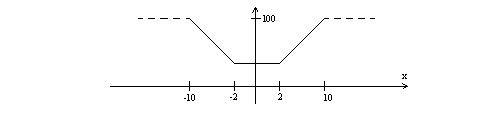
 Positioning forward/backward + analog reference to specify
 the speed. Positional error greater than 10 will result in
 a maximum speed of 100. Positional error less than 2 will give
 a minimum speed of 10. Positional error between 2 and 10 gives
 linear speed in the interval 10 and 100.

 The positional error ( position - set value) is connected to a
 Curve object. A Table object with 4 pairs of numbers is needed:

 X1 = -10 Y1 = 100 X2 = -2 Y2 = 10
 X3 = 2 Y3 = 10 X4 = 10 Y4 = 100
Example 3
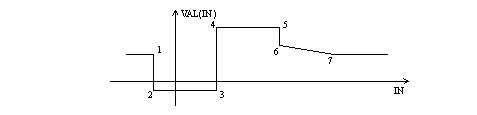
Square signal.
 The output has to be connected to a Curve object.

 TabVect[0]
 Specifies the current number of pairs of numbers in the
 table.

 TabVect[1], TabVect[2]
 The initial pair of numbers {x1, y1}

 TabVect[3], TabVect[4]
 The second pair of numbers {x2, y2}
