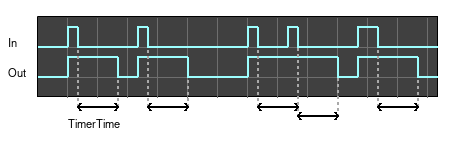
Off-state or reset delay.

 When the input becomes

  - TRUE the output is set.
  - FALSE the timer is started. After the time TimerTime
    the output will be reset.
Compare with the Wait object.
|
RtBody attributes pwr_sClass_timer |
| Boolean |
in |
in |
The input signal. |
| Boolean |
Status |
sts |
Specifies current status of the object. |
| Boolean |
StatusOld |
StatusOld |
Last In value. |
| Boolean |
TimerFlag |
|
Indicates an active timer. |
| Pointer to Boolean |
TimerNext |
|
Points to the next element in the timer queue. |
| UInt32 |
TimerCount |
|
Number of remaining ticks. |
| Pointer to Boolean |
TimerDO |
|
 Points to a Do or Dv object or, if these are not used,
 to TimerDoDum. After a time of TimerTime the signal
specified by TimerDo is cleared. |
| Float32 |
TimerTime |
|
 Specifies the reset delay, in seconds. TimerTime has to
 be >= execution time of the PLC program containing the
 object.
 The effective time can, according to the current
 CPU-load, be longer (e.g. one PLC program cycle in slow
 running PLC programs ) and shorter ( as described at
 fast running PLC programs) than the time specified by
TimerTime. |
| Boolean |
TimerDODum |
|
 Dummy. If TimerDoDum does not point to a Do or Dv
object it points to this attribute. |
| Objid |
TimerObjDId |
|
 Identity of this object is set at load file creation.
Used by the run time system. |
| Int32 |
TimerAcc |
|
 The operator's authorities to change TimerTime. Not
 implemented.
  0   -- Changes not allowed.
!= 0 -- Changes allowed. |
| Float32 |
TimerMin |
|
 Specifies a valid interval at changes made by the
 operator on TimerTime.
TimerMin <= TimerTime <= TimerMax |
| Float32 |
TimerMax |
|
|
|
DevBody attributes |
| Boolean |
ShowTimerTime |
|
 Specifies if TimerTime is to be displayed in the symbol
 of the Timer object or not. FALSE means no displaying
and TRUE displaying. The unit is seconds. |
| PlcNode |
PlcNode |
|
|
| GraphPlcNode |
| object_type |
98 |
| parameters[0] |
1 |
| parameters[1] |
0 |
| parameters[2] |
1 |
| parameters[3] |
0 |
| subwindows |
0 |
| graphmethod |
1 (standard, common attributes) |
| graphindex |
0 |
| default_mask[0] |
1 |
| default_mask[1] |
1 |
| segname_annotation |
1 |
| rtbody_annotation |
1 |
| compmethod |
5 |
| compindex |
0 |
| tracemethod |
3 |
| traceindex |
1 |
| executeordermethod |
2 |
| objname |
Timer |
| graphname |
Timer |
| debugpar |
Status |
| Template Object |
| ShowTimerTime |
1 |
Attributes detail
Specifies current status of the object.
Indicates an active timer.
Points to the next element in the timer queue.
Number of remaining ticks.
Points to a Do or Dv object or, if these are not used,
to TimerDoDum. After a time of TimerTime the signal
specified by TimerDo is cleared.
Specifies the reset delay, in seconds. TimerTime has to
be >= execution time of the PLC program containing the
object.
The effective time can, according to the current
CPU-load, be longer (e.g. one PLC program cycle in slow
running PLC programs ) and shorter ( as described at
fast running PLC programs) than the time specified by
TimerTime.
Dummy. If TimerDoDum does not point to a Do or Dv
object it points to this attribute.
Identity of this object is set at load file creation.
Used by the run time system.
The operator's authorities to change TimerTime. Not
implemented.
0 -- Changes not allowed.
!= 0 -- Changes allowed.
Specifies a valid interval at changes made by the
operator on TimerTime.
TimerMin <= TimerTime <= TimerMax
Specifies if TimerTime is to be displayed in the symbol
of the Timer object or not. FALSE means no displaying
and TRUE displaying. The unit is seconds.
