On-state or set delay with hold function.
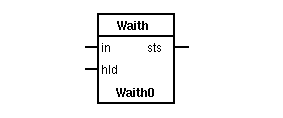
 The time, TimerTime, starts on a leading edge on the
 input and is measured by a counter.
 The countdown is disabled as long as the h(o)ld-signal
 is set. If the in-signal becomes FALSE the counter is
 cleared independent of the hld-signal.

 When the time TimerTime expires and if the input still
 remains TRUE the output is set. It is cleared as soon
 as the input becomes FALSE.
Example
 In this example TimerTime is 5 seconds which gives
 TimerCount the value 250.
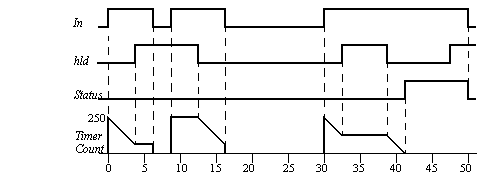
 As seen in this illustration the function is exactly as
 in a Wait object, with the exception of a set hld-signal
freezing the down counting.
See also
|
RtBody attributes pwr_sClass_waith |
| Boolean |
in |
in |
The input signal which is to be delayed. |
| Boolean |
hld |
hld |
 Specifies whether to enable or disable the hold
 function. FALSE enables the countdown, but TRUE
disables the hold function. |
| Boolean |
Status |
sts |
Delayed signal. |
| Boolean |
StatusOld |
StatusOld |
StatusOld |
| Int32 |
CountOld |
CountOld |
 Value of the counter at disabled down counting, i.e.
when hld becomes TRUE. |
| Boolean |
TimerFlag |
|
Indicates an active timer. |
| Pointer to Boolean |
TimerNext |
|
Points to the next element in the timer queue. |
| UInt32 |
TimerCount |
|
Number of remaining ticks. |
| Pointer to Boolean |
TimerDO |
|
 Points to a Do or Dv object or, if these are not used,
 to TimerDoDum. After a time of TimerTime the signal
specified by TimerDo is cleared. |
| Float32 |
TimerTime |
|
 Specifies the set delay, in seconds. TimerTime has to
 be >= execution time of the PLC program containing the
 object.

 The effective time can, according to the current
 CPU-load, be longer (e.g. one PLC program cycle in
 slowly running PLC programs ) and shorter ( as
 described for fast running PLC programs) than the time
specified by TimerTime. |
| Boolean |
TimerDODum |
|
 Dummy. If TimerDoDum does not point to a Do or Dv
object it points to this attribute. |
| Objid |
TimerObjDId |
|
 Identity of this object is set at load file creation.
Used by the run time system. |
| Int32 |
TimerAcc |
|
 The operator's authorities to change TimerTime. Not
 implemented.

  0   -- Changes not allowed.
!= 0 -- Changes allowed. |
| Float32 |
TimerMin |
|
 Specifies a valid interval at changes made by the
 operator on TimerTime.

TimerMin <= TimerTime <= TimerMax |
| Float32 |
TimerMax |
|
|
| GraphPlcNode |
| object_type |
103 |
| parameters[0] |
2 |
| parameters[1] |
0 |
| parameters[2] |
1 |
| parameters[3] |
0 |
| subwindows |
0 |
| graphmethod |
0 (standard, individual attributes) |
| graphindex |
0 |
| default_mask[0] |
3 |
| default_mask[1] |
1 |
| segname_annotation |
1 |
| compmethod |
5 |
| compindex |
0 |
| tracemethod |
3 |
| traceindex |
1 |
| executeordermethod |
2 |
| objname |
Waith |
| graphname |
Waith |
| debugpar |
Status |
Attributes detail
The input signal which is to be delayed.
Specifies whether to enable or disable the hold
function. FALSE enables the countdown, but TRUE
disables the hold function.
Value of the counter at disabled down counting, i.e.
when hld becomes TRUE.
Indicates an active timer.
Points to the next element in the timer queue.
Number of remaining ticks.
Points to a Do or Dv object or, if these are not used,
to TimerDoDum. After a time of TimerTime the signal
specified by TimerDo is cleared.
Specifies the set delay, in seconds. TimerTime has to
be >= execution time of the PLC program containing the
object.
The effective time can, according to the current
CPU-load, be longer (e.g. one PLC program cycle in
slowly running PLC programs ) and shorter ( as
described for fast running PLC programs) than the time
specified by TimerTime.
Dummy. If TimerDoDum does not point to a Do or Dv
object it points to this attribute.
Identity of this object is set at load file creation.
Used by the run time system.
The operator's authorities to change TimerTime. Not
implemented.
0 -- Changes not allowed.
!= 0 -- Changes allowed.
Specifies a valid interval at changes made by the
operator on TimerTime.
TimerMin <= TimerTime <= TimerMax
