
| Volume pwrb | |
| Attributes: Runtime | Development | System | Template | Detail C Binding: Struct | Class | Code ClassTree | INDEX NO INDEX |
|
Class Valve
|
||
|---|---|---|
| Version | 1.0 | |
| Modified | 08-MAR-2026 11:05:32.00 | |
| Code | rt_plc_drive.c | |
 Valve positioner with two states, i.e. on-off action
 and operation time supervision.
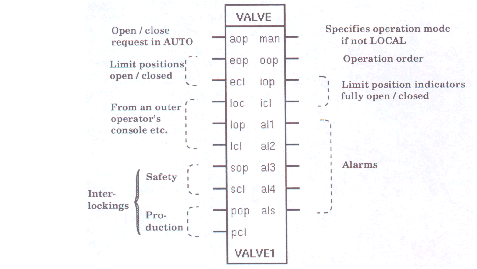
 The two operating states, here named OPEN and CLOSE,
 can be interpreted as full on or full off, open or
 closed etc. The operation order OrderOpen is either
 TRUE or FALSE.

 By means of the operation time supervision it is
 possible to detect if the final control element is
 stopped between the two operating states.
 One of three operating modes, LOCAL / MANUAL / AUTO, is
 selected by means of the input signal Local and the
 output signal ManMode in the following way:
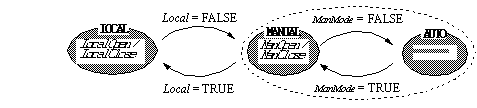
LOCAL
 Used at operation from for example an outer
 operator's console, switching equipment, etc.

 - Only the safety interlockings, SafeOpen and
   SafeClose, are taken into account.

 - LocalOpen has a spring back push button
   function. It sets OrderOpen to TRUE when
   activated.

 - LocalClose has a spring back push button
   function. It resets OrderOpen when
   activated.

 - At the changes,
   -- LOCAL --> AUTO AutoOpen is concerned.
   -- LOCAL --> MANUAL OrderOpen remains unaffected.
MANUAL/AUTO
 - Both production and safety interlockings are
   concerned.

 - The alarms are indicators that do not
   influence the operation order unless they
   are connected to some interlocking signal.

 - In MANUAL mode OPEN/CLOSE request is handled
   by the operator by means of the attributes
   ManOpen respectively ManClose.

   In AUTO mode OPEN request is done when
   AutoOpen is TRUE; CLOSE when AutoOpen is
   FALSE, i.e. not at any edge but on the
   levels.

 - The changes,
   -- AUTO -> MANUAL, do not influence the
      operation order OrderOpen.

   -- MANUAL -> AUTO. If the operation order was
      set in MANUAL operating mode and AutoOpen is TRUE,
      the operation order remains set after the transition,
      otherwise not.

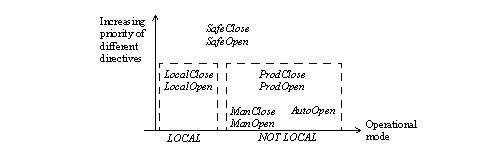
 If there are conflicting requests the request with the
 highest priority wins; see below.
Pump with a valve

 At request to start the pump shall the valve first open
 and then the pump start.
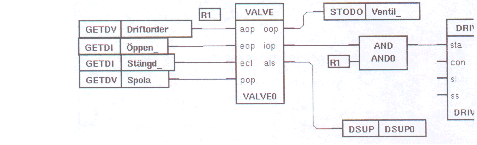
 At flushing the valve has to be opened, and this is done
 by means of the Dv- signal 'Spola'.
| RtBody attributes pwr_sClass_valve | |||
|---|---|---|---|
| Boolean | AutoOpen | aop | Specifies an OPEN/CLOSE request in operational mode AUTO. FALSE means CLOSE request and TRUE means OPEN request. |
| Boolean | EndOpen | eop | Specifies whether the end limit position of OPEN is activated or not. FALSE means no and TRUE means that the answer is yes. Used by Alarm1 and Alarm3. |
| Boolean | EndClose | ecl | Specifies whether the end limit position of CLOSE is activated or not. FALSE means no and TRUE means that the answer is yes. Used by Alarm2 and Alarm4. |
| Boolean | Local | loc | Selection of operational mode. The signal may proceed from a rotary switch, for example. FALSE means that the operational mode 'NOT LOCAL' is selected and ManMode if this is MANUAL or AUTO. TRUE means that the operational mode LOCAL has been selected. |
| Boolean | LocalOpen | lop | Specifies OPEN request in operational mode LOCAL. FALSE means no action; TRUE implies the operation order OrderOpen has been set and will be set until a new CLOSE request is made. |
| Boolean | LocalClose | lcl | Specifies CLOSE request in operational mode LOCAL. FALSE means no action; TRUE implies that the operation order OrderOpen has been reset and will be is reset until a new OPEN request is made. |
| Boolean | SafeOpen | sop | Specifies the state of the safety interlocking at OPEN operation. This interlocking is valid independent of operational mode. FALSE means that this safety interlocking is not activated. TRUE means unconditional OPEN, i.e. the operation order OrderOpen is set unless SafeClose is also TRUE. If SafeClose = SafeOpen = TRUE SafeClose wins. |
| Boolean | SafeClose | scl | Specifies the state of the safety interlocking at CLOSE operation. This interlocking is valid independent of operational mode. FALSE means that this safety interlocking is not activated. TRUE means unconditional CLOSE, i.e. the operation order OrderOpen is reset. |
| Boolean | ProdOpen | pop | Specifies the state of the production interlocking at OPEN operation and is valid only for the operational modes AUTO and MANUAL. FALSE means that the production interlocking is not activated. TRUE means that the operation order OrderOpen is set, unless SafeClose, ProdClose, or Local is set. |
| Boolean | ProdClose | pcl | Specifies the state of the production interlocking at CLOSE operation and is valid only for the operational modes AUTO and MANUAL. FALSE means that the production interlocking is not activated. TRUE means that the operation order OrderOpen is reset, unless SafeOpen or Local is set. |
| Boolean | ManMode | man | Specifies required operational mode ( MANUAL or AUTO) when LOCAL is FALSE. Used as an ordinary parameter, e.g. it may be written into from display programs. The advantage of placing this attribute as an output is that it will be easier to use it in the graphic configuration. If Local is FALSE means: FALSE -- required operational mode is AUTO TRUE -- - " - MANUAL |
| Boolean | OrderOpen | oop | The operational order specifies one out of two operating states; full on or full off, open or closed etc. FALSE means here a state named CLOSE, and TRUE means a state named OPEN. |
| Boolean | IndOpen | iop | The attribute is a confirmation of the current OPENING-operating state depending on other attributes. TRUE indicates OrderOpen = EndOpen = TRUE and EndClosed = Local = FALSE, otherwise IndOpen is FALSE. |
| Boolean | IndClose | icl | The attribute is a confirmation of the current CLOSING-operating state depending on other attributes. TRUE indicates EndClosed = TRUE and OrderOpen = EndOpen = Local = FALSE, otherwise IndClose is FALSE. |
| Boolean | Alarm1 | al1 | Specifies if the OrderOpen has been set during a time longer than TimerTime without any activating of the end position, i.e. EndOpen has not been set. FALSE means no alarm; TRUE means that EndOpen was not set within the time limit value TimerTim. The operational order, OrderOpen, is not influenced by the alarm. The alarm remains until EndOpen is TRUE or a CLOSE request is made. Connects a DSup object to the output if a message will be sent and specifies DetectText in the DSup object; e.g. 'Too long operation time at OPEN-order on xxx' |
| Boolean | Alarm2 | al2 | Specifies if the OrderOpen has been reset during a time longer than TimerTime without any activating of the end position, i.e. EndClosed has not been set. FALSE means no alarm; TRUE means that EndClosed was not set within the time limit value TimerTim. The operational order, OrderOpen, is not influenced by the alarm. The alarm remains until EndClosed is TRUE or an OPEN request is made. Connects a DSup object to the output, if a message will be sent and specifies DetectText in the DSup object; e.g. 'Too long operation time at CLOSE-order on xxx' |
| Boolean | Alarm3 | al3 | Specifies if the EndOpen signal is lost through a continued OPENING-order or if both the limit position indicators ( EndClose and EndClosed) are activated at the same time. The operational order, OrderOpen, is not influenced by the alarm. The alarm remains as long as the alarm position exists. Connects a DSup object to the output, if a message will be sent, and specifies DetectText in the DSup object; e.g. 'Lost limit position OPENED on xxx'. |
| Boolean | Alarm4 | al4 | Specifies if the EndClosed signal is lost through a continued CLOSING-order or, if both the limit position indicators ( EndClose and EndClosed) are activated at the same time. The operational order, OrderOpen, is not influenced by the alarm. The alarm remains as long as the alarm position exists. Connects a DSup object to the output, if a message will be sent, and specifies DetectText in the DSup object; e.g. 'Lost limit position CLOSED on xxx'. If EndClose = EndOpen = TRUE both Alarm3 and Alarm4 are set. |
| Boolean | SumAlarm | als | Sum of alarms. Specifies if any of the alarms exist or not. FALSE means no active alarms at all in this object; TRUE means that at least one of Alarm1, ... , Alarm4 is on. The operational order, OrderOpen, is not influenced by the alarm. Connects a DSup object to the output, if a message will be sent, and specifies DetectText in the DSup object. |
| Boolean | ManOpen | Specifies OPEN request in the operational mode MANUAL. FALSE means no request; TRUE means OPEN request. The request is reset by the ProviewR system when it has been noticed. |
|
| Boolean | ManClose | Specifies CLOSE request in the operational mode MANUAL. FALSE means no request; TRUE means CLOSE request. The request is reset by the ProviewR system when it has been noticed. |
|
| Boolean | TimerFlag | Indicates an active timer. | |
| Pointer to Boolean | TimerNext | Points to the next element in the timer queue. | |
| UInt32 | TimerCount | Number of remaining ticks. | |
| Pointer to Boolean | TimerDO | Points to a Do or Dv object or, if these are not used, to TimerDoDum. After a time of TimerTime the signal specified by TimerDo is cleared. |
|
| Float32 | TimerTime | The value, in seconds, of the operation timer. If the OrderOpen has been set or reset during a time longer than TimerTime without any activating of the end corresponding position Alarm1 or Alarm2 is set. |
|
| Boolean | TimerDODum | Dummy. If TimerDoDum does not point to a Do or Dv object it points to this attribute. |
|
| Objid | TimerObjDId | Identity of this object is set at load file creation. Used by the run time system. |
|
| Int32 | ManAcc | ManAcc | The operator's authorities to change between the operational modes MANUAL / AUTO can be restricted. 0 -- Changes not allowed. != 0 -- Changes allowed. |
| Int32 | Status | Status | The possible status values are as follows: 1 or -1 -- Waiting for OPEN or CLOSE indication 2 or -2 -- OPENING or CLOSING 3 or -3 -- OPEN or CLOSED |
| DevBody attributes | |||
|---|---|---|---|
| PlcNode | PlcNode | ||
| GraphPlcNode | |
|---|---|
| object_type | 181 |
| parameters[0] | 10 |
| parameters[1] | 0 |
| parameters[2] | 9 |
| parameters[3] | 0 |
| subwindows | 0 |
| graphmethod | 0 (standard, individual attributes) |
| graphindex | 0 |
| default_mask[0] | 7 |
| default_mask[1] | 270 |
| segname_annotation | 1 |
| compmethod | 4 |
| compindex | 0 |
| executeordermethod | 2 |
| objname | Valve |
| graphname | Valve |
| debugpar | |
| Template Object | |
|---|---|
| TimerTime | 10.0 |
| AutoOpen Input | ||
|---|---|---|
| Class | Input | |
| Type | Boolean | |
| Flags | STATE | NOEDIT | NOINVERT | REDUTRANSFER | |
| GraphName | aop | |
| Body | RtBody | |
 Specifies an OPEN/CLOSE request in operational mode
 AUTO. FALSE means CLOSE request and TRUE means OPEN
 request.
| EndOpen Input | ||
|---|---|---|
| Class | Input | |
| Type | Boolean | |
| Flags | STATE | NOEDIT | NOINVERT | REDUTRANSFER | |
| GraphName | eop | |
| Body | RtBody | |
 Specifies whether the end limit position of OPEN is
 activated or not. FALSE means no and TRUE means that
 the answer is yes.

 Used by Alarm1 and Alarm3.
| EndClose Input | ||
|---|---|---|
| Class | Input | |
| Type | Boolean | |
| Flags | STATE | NOEDIT | NOINVERT | REDUTRANSFER | |
| GraphName | ecl | |
| Body | RtBody | |
 Specifies whether the end limit position of CLOSE is
 activated or not. FALSE means no and TRUE means that
 the answer is yes.
 Used by Alarm2 and Alarm4.
| Local Input | ||
|---|---|---|
| Class | Input | |
| Type | Boolean | |
| Flags | NOINVERT | REDUTRANSFER | |
| GraphName | loc | |
| Body | RtBody | |
 Selection of operational mode. The signal may proceed
 from a rotary switch, for example. FALSE means that the
 operational mode 'NOT LOCAL' is selected and ManMode if
 this is MANUAL or AUTO. TRUE means that the operational
 mode LOCAL has been selected.
| LocalOpen Input | ||
|---|---|---|
| Class | Input | |
| Type | Boolean | |
| Flags | NOINVERT | REDUTRANSFER | |
| GraphName | lop | |
| Body | RtBody | |
 Specifies OPEN request in operational mode LOCAL. FALSE
 means no action; TRUE implies the operation order
 OrderOpen has been set and will be set until a new
 CLOSE request is made.
| LocalClose Input | ||
|---|---|---|
| Class | Input | |
| Type | Boolean | |
| Flags | REDUTRANSFER | NOINVERT | |
| GraphName | lcl | |
| Body | RtBody | |
 Specifies CLOSE request in operational mode LOCAL.
 FALSE means no action; TRUE implies that the operation
 order OrderOpen has been reset and will be is reset
 until a new OPEN request is made.
| SafeOpen Input | ||
|---|---|---|
| Class | Input | |
| Type | Boolean | |
| Flags | NOINVERT | REDUTRANSFER | |
| GraphName | sop | |
| Body | RtBody | |
 Specifies the state of the safety interlocking at OPEN
 operation. This interlocking is valid independent of
 operational mode.

 FALSE means that this safety interlocking is not
 activated. TRUE means unconditional OPEN, i.e. the
 operation order OrderOpen is set unless SafeClose is
 also TRUE. If SafeClose = SafeOpen = TRUE SafeClose
 wins.
| SafeClose Input | ||
|---|---|---|
| Class | Input | |
| Type | Boolean | |
| Flags | NOINVERT | REDUTRANSFER | |
| GraphName | scl | |
| Body | RtBody | |
 Specifies the state of the safety interlocking at CLOSE
 operation. This interlocking is valid independent of
 operational mode.
 FALSE means that this safety interlocking is not
 activated. TRUE means unconditional CLOSE, i.e. the
 operation order OrderOpen is reset.
| ProdOpen Input | ||
|---|---|---|
| Class | Input | |
| Type | Boolean | |
| Flags | NOINVERT | REDUTRANSFER | |
| GraphName | pop | |
| Body | RtBody | |
 Specifies the state of the production interlocking at
 OPEN operation and is valid only for the operational
 modes AUTO and MANUAL. FALSE means that the production
 interlocking is not activated. TRUE means that the
 operation order OrderOpen is set, unless SafeClose,
 ProdClose, or Local is set.
| ProdClose Input | ||
|---|---|---|
| Class | Input | |
| Type | Boolean | |
| Flags | NOINVERT | REDUTRANSFER | |
| GraphName | pcl | |
| Body | RtBody | |
 Specifies the state of the production interlocking at
 CLOSE operation and is valid only for the operational
 modes AUTO and MANUAL. FALSE means that the production
 interlocking is not activated. TRUE means that the
 operation order OrderOpen is reset, unless SafeOpen or
 Local is set.
| ManMode Output | ||
|---|---|---|
| Class | Output | |
| Type | Boolean | |
| Flags | STATE | NOEDIT | REDUTRANSFER | |
| GraphName | man | |
| Body | RtBody | |
 Specifies required operational mode ( MANUAL or AUTO)
 when LOCAL is FALSE. Used as an ordinary parameter,
 e.g. it may be written into from display programs. The
 advantage of placing this attribute as an output is
 that it will be easier to use it in the graphic
 configuration. If Local is FALSE means:

   FALSE -- required operational mode is AUTO
   TRUE  --    -  "  -              MANUAL
| OrderOpen Output | ||
|---|---|---|
| Class | Output | |
| Type | Boolean | |
| Flags | STATE | NOEDIT | REDUTRANSFER | |
| GraphName | oop | |
| Body | RtBody | |
 The operational order specifies one out of two
 operating states; full on or full off, open or closed
 etc. FALSE means here a state named CLOSE, and TRUE
 means a state named OPEN.
| IndOpen Output | ||
|---|---|---|
| Class | Output | |
| Type | Boolean | |
| Flags | STATE | NOEDIT | REDUTRANSFER | |
| GraphName | iop | |
| Body | RtBody | |
 The attribute is a confirmation of the current
 OPENING-operating state depending on other attributes.
 TRUE indicates OrderOpen = EndOpen = TRUE and EndClosed
 = Local = FALSE, otherwise IndOpen is FALSE.
| IndClose Output | ||
|---|---|---|
| Class | Output | |
| Type | Boolean | |
| Flags | STATE | NOEDIT | REDUTRANSFER | |
| GraphName | icl | |
| Body | RtBody | |
 The attribute is a confirmation of the current
 CLOSING-operating state depending on other attributes.
 TRUE indicates EndClosed = TRUE and OrderOpen = EndOpen
 = Local = FALSE, otherwise IndClose is FALSE.
| Alarm1 Output | ||
|---|---|---|
| Class | Output | |
| Type | Boolean | |
| Flags | STATE | NOEDIT | REDUTRANSFER | |
| GraphName | al1 | |
| Body | RtBody | |
 Specifies if the OrderOpen has been set during a time
 longer than TimerTime without any activating of the end
 position, i.e. EndOpen has not been set.

 FALSE means no alarm; TRUE means that EndOpen was not
 set within the time limit value TimerTim. The
 operational order, OrderOpen, is not influenced by the
 alarm. The alarm remains until EndOpen is TRUE or a
 CLOSE request is made.
 Connects a DSup object to the output if a message will
 be sent and specifies DetectText in the DSup object;
 e.g. 'Too long operation time at OPEN-order on xxx'
| Alarm2 Output | ||
|---|---|---|
| Class | Output | |
| Type | Boolean | |
| Flags | STATE | NOEDIT | REDUTRANSFER | |
| GraphName | al2 | |
| Body | RtBody | |
 Specifies if the OrderOpen has been reset during a time
 longer than TimerTime without any activating of the end
 position, i.e. EndClosed has not been set.
 FALSE means no alarm; TRUE means that EndClosed was not
 set within the time limit value TimerTim. The
 operational order, OrderOpen, is not influenced by the
 alarm. The alarm remains until EndClosed is TRUE or an
 OPEN request is made.
 Connects a DSup object to the output, if a message will
 be sent and specifies DetectText in the DSup object;
 e.g. 'Too long operation time at CLOSE-order on xxx'
| Alarm3 Output | ||
|---|---|---|
| Class | Output | |
| Type | Boolean | |
| Flags | STATE | NOEDIT | REDUTRANSFER | |
| GraphName | al3 | |
| Body | RtBody | |
 Specifies if the EndOpen signal is lost through a
 continued OPENING-order or if both the limit position
 indicators ( EndClose and EndClosed) are activated at
 the same time. The operational order, OrderOpen, is not
 influenced by the alarm. The alarm remains as long as
 the alarm position exists.

 Connects a DSup object to the output, if a message will
 be sent, and specifies DetectText in the DSup object;
 e.g. 'Lost limit position OPENED on xxx'.
| Alarm4 Output | ||
|---|---|---|
| Class | Output | |
| Type | Boolean | |
| Flags | STATE | NOEDIT | REDUTRANSFER | |
| GraphName | al4 | |
| Body | RtBody | |
 Specifies if the EndClosed signal is lost through a
 continued CLOSING-order or, if both the limit position
 indicators ( EndClose and EndClosed) are activated at
 the same time. The operational order, OrderOpen, is not
 influenced by the alarm. The alarm remains as long as
 the alarm position exists.

 Connects a DSup object to the output, if a message will
 be sent, and specifies DetectText in the DSup object;
 e.g. 'Lost limit position CLOSED on xxx'.
 If EndClose = EndOpen = TRUE both Alarm3 and Alarm4 are
 set.
| SumAlarm Output | ||
|---|---|---|
| Class | Output | |
| Type | Boolean | |
| Flags | STATE | NOEDIT | REDUTRANSFER | |
| GraphName | als | |
| Body | RtBody | |
 Sum of alarms. Specifies if any of the alarms exist or
 not. FALSE means no active alarms at all in this
 object; TRUE means that at least one of Alarm1, ... ,
 Alarm4 is on. The operational order, OrderOpen, is not
 influenced by the alarm.
 Connects a DSup object to the output, if a message will
 be sent, and specifies DetectText in the DSup object.
| ManOpen Intern | ||
|---|---|---|
| Class | Intern | |
| Type | Boolean | |
| Flags | STATE | NOEDIT | REDUTRANSFER | |
| Body | RtBody | |
 Specifies OPEN request in the operational mode MANUAL.
 FALSE means no request; TRUE means OPEN request. The
 request is reset by the ProviewR system when it has
 been noticed.
| ManClose Intern | ||
|---|---|---|
| Class | Intern | |
| Type | Boolean | |
| Flags | STATE | NOEDIT | REDUTRANSFER | |
| Body | RtBody | |
 Specifies CLOSE request in the operational mode MANUAL.
 FALSE means no request; TRUE means CLOSE request. The
 request is reset by the ProviewR system when it has
 been noticed.
| TimerFlag Intern | ||
|---|---|---|
| Class | Intern | |
| Type | Boolean | |
| Flags | STATE | INVISIBLE | REDUTRANSFER | |
| Body | RtBody | |
Indicates an active timer.
| TimerNext Intern | ||
|---|---|---|
| Class | Intern | |
| Type | Pointer to Boolean | |
| Flags | POINTER | STATE | INVISIBLE | PRIVATE | |
| Body | RtBody | |
Points to the next element in the timer queue.
| TimerCount Intern | ||
|---|---|---|
| Class | Intern | |
| Type | UInt32 | |
| Flags | STATE | INVISIBLE | REDUTRANSFER | |
| Body | RtBody | |
Number of remaining ticks.
| TimerDO Intern | ||
|---|---|---|
| Class | Intern | |
| Type | Pointer to Boolean | |
| Flags | POINTER | STATE | INVISIBLE | PRIVATE | |
| Body | RtBody | |
 Points to a Do or Dv object or, if these are not used,
 to TimerDoDum. After a time of TimerTime the signal
 specified by TimerDo is cleared.
| TimerTime Intern | ||
|---|---|---|
| Class | Intern | |
| Type | Float32 | |
| Flags | REDUTRANSFER | |
| Body | RtBody | |
 The value, in seconds, of the operation timer. If the
 OrderOpen has been set or reset during a time longer
 than TimerTime without any activating of the end
 corresponding position Alarm1 or Alarm2 is set.
| TimerDODum Intern | ||
|---|---|---|
| Class | Intern | |
| Type | Boolean | |
| Flags | STATE | INVISIBLE | |
| Body | RtBody | |
 Dummy. If TimerDoDum does not point to a Do or Dv
 object it points to this attribute.
| TimerObjDId Intern | ||
|---|---|---|
| Class | Intern | |
| Type | Objid | |
| Flags | INVISIBLE | |
| Body | RtBody | |
 Identity of this object is set at load file creation.
 Used by the run time system.
| ManAcc Intern | ||
|---|---|---|
| Class | Intern | |
| Type | Int32 | |
| Flags | ||
| GraphName | ManAcc | |
| Body | RtBody | |
 The operator's authorities to change between the
 operational modes MANUAL / AUTO can be restricted.
    0   -- Changes not allowed.
    != 0 -- Changes allowed.
| Status Intern | ||
|---|---|---|
| Class | Intern | |
| Type | Int32 | |
| Flags | STATE | NOEDIT | |
| GraphName | Status | |
| Body | RtBody | |
 The possible status values are as follows:

  1 or -1 -- Waiting for OPEN or CLOSE indication
  2 or -2 -- OPENING or CLOSING
  3 or -3 -- OPEN or CLOSED
| PlcNode Buffer | ||
|---|---|---|
| Class | Buffer | |
| Type | PlcNode | |
| Flags | INVISIBLE | |
| Body | DevBody | |