On-state or set delay.

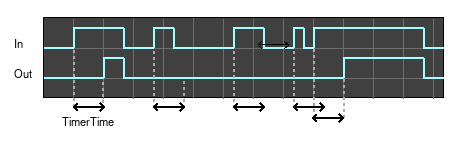
 The time starts on a leading edge on the input. When
 the time TimerTime expires and if the input still
 remains TRUE the output is set. It is cleared as soon
 as the input becomes FALSE.
See also
|
RtBody attributes pwr_sClass_wait |
| Boolean |
in |
in |
The input signal which is to be delayed. |
| Boolean |
Status |
sts |
Delayed signal. |
| Boolean |
StatusOld |
StatusOld |
|
| Boolean |
TimerFlag |
|
Indicates an active timer. |
| Pointer to Boolean |
TimerNext |
|
Points to the next element in the timer queue. |
| UInt32 |
TimerCount |
|
Number of remaining ticks. |
| Pointer to Boolean |
TimerDO |
|
 Points to a Do or Dv object or, if these are not used,
 to TimerDoDum. After a time of TimerTime the signal
specified by TimerDo is cleared. |
| Float32 |
TimerTime |
|
 Specifies the set delay, in seconds. TimerTime has to
 be ³ execution time of the PLC program containing the
 object.
 The effective time can, according to the current
 CPU-load, be longer (e.g. one PLC program cycle in
 slowly running PLC programs ) and shorter ( as
 described for fast running PLC programs) than the time
specified by TimerTime. |
| Boolean |
TimerDODum |
|
 Dummy. If TimerDoDum does not point to a Do or Dv
object it points to this attribute. |
| Objid |
TimerObjDId |
|
 Identity of this object is set at load file creation.
Used by the run time system. |
| Int32 |
TimerAcc |
|
 The operator's authorities to change TimerTime. Not
 implemented.

  0   -- Changes not allowed.
!= 0 -- Changes allowed. |
| Float32 |
TimerMin |
|
 Specifies a valid interval at changes made by the
 operator on TimerTime.

TimerMin <= TimerTime <= TimerMax |
| Float32 |
TimerMax |
|
|
|
DevBody attributes |
| Boolean |
ShowTimerTime |
|
 Specifies if TimerTime is to be displayed in the symbol
 of the Wait object or not. FALSE means no displaying
and TRUE displaying. The unit is seconds. |
| PlcNode |
PlcNode |
|
|
| GraphPlcNode |
| object_type |
97 |
| parameters[0] |
1 |
| parameters[1] |
0 |
| parameters[2] |
1 |
| parameters[3] |
0 |
| subwindows |
0 |
| graphmethod |
1 (standard, common attributes) |
| graphindex |
0 |
| default_mask[0] |
1 |
| default_mask[1] |
1 |
| segname_annotation |
1 |
| rtbody_annotation |
1 |
| compmethod |
5 |
| compindex |
0 |
| tracemethod |
3 |
| traceindex |
1 |
| executeordermethod |
2 |
| objname |
Wait |
| graphname |
Wait |
| debugpar |
Status |
| Template Object |
| ShowTimerTime |
1 |
Attributes detail
The input signal which is to be delayed.
Indicates an active timer.
Points to the next element in the timer queue.
Number of remaining ticks.
Points to a Do or Dv object or, if these are not used,
to TimerDoDum. After a time of TimerTime the signal
specified by TimerDo is cleared.
Specifies the set delay, in seconds. TimerTime has to
be ³ execution time of the PLC program containing the
object.
The effective time can, according to the current
CPU-load, be longer (e.g. one PLC program cycle in
slowly running PLC programs ) and shorter ( as
described for fast running PLC programs) than the time
specified by TimerTime.
Dummy. If TimerDoDum does not point to a Do or Dv
object it points to this attribute.
Identity of this object is set at load file creation.
Used by the run time system.
The operator's authorities to change TimerTime. Not
implemented.
0 -- Changes not allowed.
!= 0 -- Changes allowed.
Specifies a valid interval at changes made by the
operator on TimerTime.
TimerMin <= TimerTime <= TimerMax
Specifies if TimerTime is to be displayed in the symbol
of the Wait object or not. FALSE means no displaying
and TRUE displaying. The unit is seconds.
